
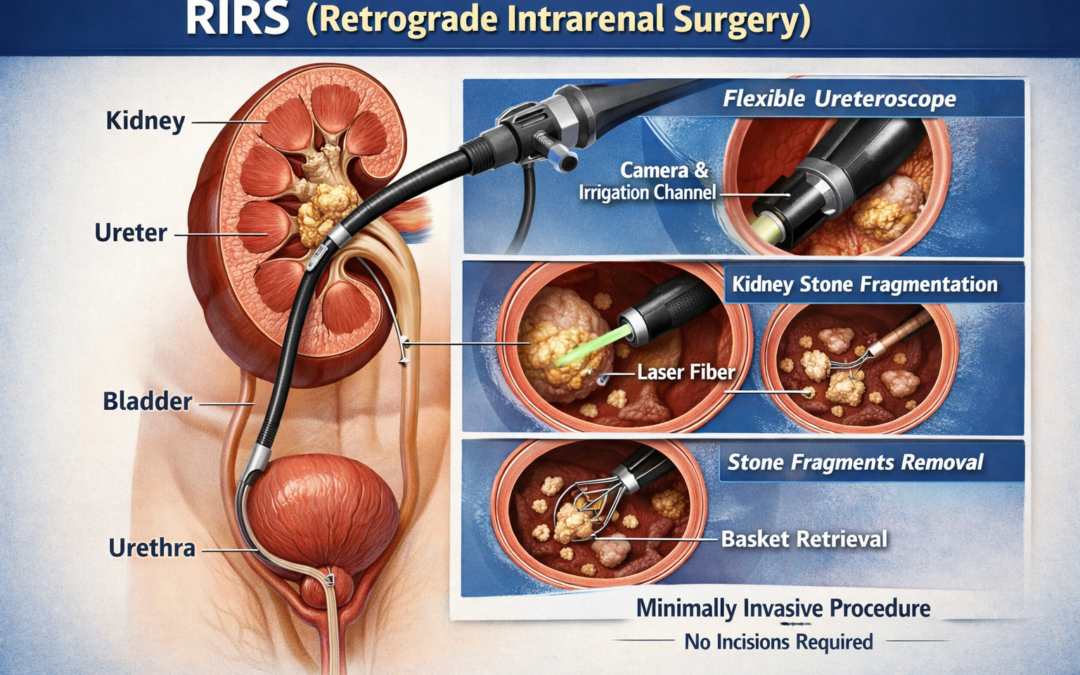
RIRS, also known as Retrograde Intrarenal Surgery, is an advanced and minimally invasive procedure used to treat kidney stones. This technique allows doctors to reach stones inside the kidney without making any cuts on the body. RIRS has become a preferred option for treating stones that are difficult to remove using other methods.
This procedure offers high success rates, minimal pain, and faster recovery, making it a safe choice for many patients.
What Is RIRS?
RIRS is a procedure in which a flexible ureteroscope is passed through the urinary tract to reach the kidney. The doctor can see the stone clearly on a screen. A laser is then used to break the stone into very small pieces.
Since the procedure is done through natural pathways, there are no scars or stitches. This makes RIRS a comfortable option for patients.
Who Can Benefit from RIRS?
RIRS is suitable for patients with kidney stones that are smaller than 2 cm and located deep inside the kidney. It is also helpful for patients with multiple stones or recurring kidney stones.
Patients who cannot undergo open surgery due to health reasons may also benefit from RIRS.
Advantages of RIRS
The main advantage of RIRS is that it avoids open surgery. Patients experience less pain, minimal bleeding, and quicker recovery. Hospital stay is usually short, and most patients can resume normal activities within a few days.
RIRS is also safe for elderly patients and those with other medical conditions.
How the Procedure Is Performed
RIRS is done under anesthesia. A flexible scope is inserted through the urinary passage to reach the kidney. Once the stone is located, a laser is used to break it into tiny fragments.
In some cases, a stent is placed temporarily to help urine flow and prevent discomfort. The procedure usually takes about 60 to 120 minutes.
Recovery After RIRS
Recovery after RIRS is generally quick. Patients may notice mild pain, slight blood in urine, or burning sensation for a few days. These symptoms usually settle on their own.
Drinking plenty of fluids helps remove stone fragments and improves healing.
Dr. Kumar Saurav performs RIRS with a focus on patient safety, comfort, and long-term kidney health.
Long-Term Care and Prevention
After RIRS, patients are advised to follow preventive measures such as staying hydrated, maintaining a healthy diet, and attending regular check-ups. Understanding the cause of stone formation helps in preventing future stones.
RIRS is an effective and modern treatment that helps patients get rid of kidney stones safely and return to daily life with confidence.